High Pressure Foam Analyzer - HPFA - Krüss
Optimize foam-supported oil production in EOR by analyzing foam stability and structure under reservoir conditions. Delivered and supported by Cromocol.
Get a Quote Optimize Enhanced Oil Recovery with Advanced Foam Analysis
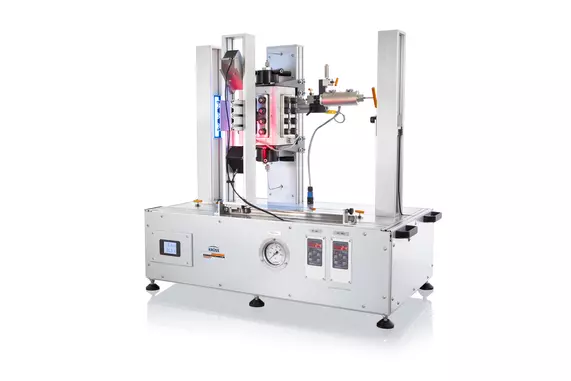
The HPFA High Pressure Foam Analyzer stands as the sole instrument globally capable of analyzing both the quantity and structure of liquid foams under elevated pressures. Uniquely designed for enhanced oil recovery (EOR) applications, this instrument offers a comprehensive suite of options to investigate foam behavior under authentic process conditions, including foam-assisted flooding and hydraulic fracturing scenarios.
Applications and Measuring Methods
From foam-assisted gas flooding to acting as a fracking liquid, the HPFA is adept at analyzing foam height and structure in high-pressure environments. It addresses the critical needs of EOR techniques and hydraulic fracturing, providing invaluable insights into maximum foam volume, liquid volume within foam, decay curves, and bubble size distribution, among many others.
Advanced Features for Comprehensive Analysis
Equipped with two high-resolution cameras operating simultaneously, the HPFA captures dynamic changes in foam height and lamellae structure during and after gas infusion. This capability, supported by real-time image evaluation via our ADVANCE software, offers an unparalleled view into foamability, stability, and decay patterns. The system’s compatibility with varying gas mediums and its ability to simulate real oil reservoir conditions make it a pivotal tool in the pursuit of optimizing EOR processes.
Enabling Detailed Foam Investigation
Aside from its primary functions, the HPFA facilitates additional dosing experiments to examine foam interactions with inhibiting phases, thereby enabling a deeper understanding of foam stability under diverse conditions. This aspect is particularly beneficial for fine-tuning foam properties to enhance oil recovery efficiency.
Technical Specifications
- Software type: ADVANCE
- Software languages: Chinese (simplified), English, French, German, Japanese, Korean, Portuguese, Russian, Spanish
- Software modules: Foam analysis – high pressure (recommended)
- Analyzed foam characteristic: foamability and foam stabilityfoam structure: homogeneity, stability and aging
- Results: foam heightliquid heighttotal heightfoam capacity (additional flow sensor needed)maximum foam densityexpansion ratefoam half life timedrainage half life timesample temperaturegas temperaturepressuremean bubble areabubble count per mm²standard deviation of mean bubble areabubble size distributionbubble count half lifeSauter mean radiusfinal foam structure
- Footprint: 1100 mm × 640 mm (W × D)
- Height: 1070 mm
- Weight (without accessories): 190 kg
- Operating temperature: 10 to 40 °C
- Humidity: without condensation
- PC: min. 1 × USB 3.0, recommended 2 × USB 3.0 and 1 × USB 2.0
- Voltage: 100 to 240 V
- Power consumption: 30 W
- Frequency: 50 to 60 Hz
- Type of temperature control: electrical
- Range of temperature control: room temperature up to 120 °C
- Filter plates for sparging: Diameter: 30 mm
- Filter plate porosities: G2: nominal maximum pore size: 40 to 100 μm (recommended)G3: nominal maximum pore size: 16 to 40 μmG4: nominal maximum pore size: 10 to 16 μm
- Material of columns and frits: borosilicate glass (norm: ISO 4793)
- Material of sealings: PTFE with glass fibers (inner) and graphite (outer) for the windowsHNBR for the filter plates
- Dosing: manual
- Location: in the high-pressure cell (top/middle/bottom)
- Temperature: maximum 180 °C
- Sensor: 1 thermocouple
- Location: in the high-pressure cell (top/middle/bottom)
- Voltage: 115 to 230 V
- Power consumption: 1880 W
- Frequency: 50 to 60 Hz
- Types: LED
- Wave length, dominant (height detection): 469 nm (blue)
- Wave length, dominant (structure detection): 633 nm (red)
- Maximum pressure: 350 bar (5000 psi) (with additional external syringe pump)
- Performance: 2 fps at 1280 × 1024 px
- Mean field of view: 25 × 13 mm²
- Diameter of minimum detectable bubble: 150 μm
- Focus: manual
- Performance: 5 fps at 1280 × 1024 px
- Spatial resolution: 200 dpi | 0.12 mm/px
- Mean field of view: 85 × 5.2 mm²
- Focus: manual
Documents & Downloads
Frequently Asked Questions
What applications is the HPFA High Pressure Foam Analyzer best suited for?
How does the HPFA measure and analyze foam?
What software is required to operate the HPFA, and what languages does it support?
What are the key specifications of the HPFA?
Can the HPFA simulate real oil reservoir conditions?
What types of dosing experiments can the HPFA facilitate?
How is the HPFA equipped for detailed foam structure analysis?
Request a quote for High Pressure Foam Analyzer - HPFA - Krüss
Fill out the form, give us a call or send an email and we will contact you as soon as possible.