3D-Laser Vibrometer - Optomet
Optomet 3D laser vibrometers use three laser beams to resolve x, y and z vibration at every point, DC-50 MHz. SMART 3D-Scan and 3D-Fiber, from Cromocol.
Get a Quote Product Description
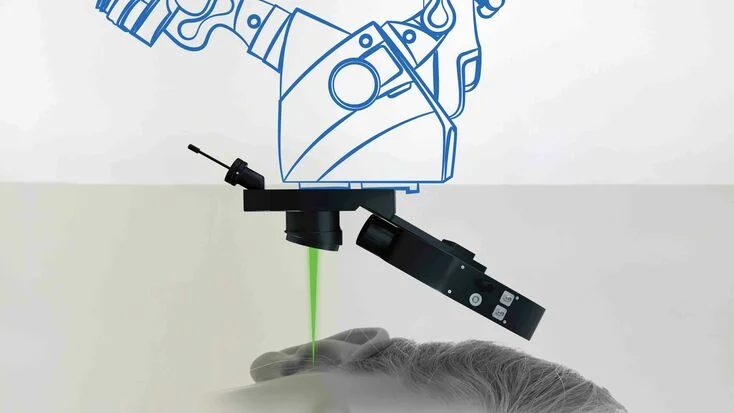
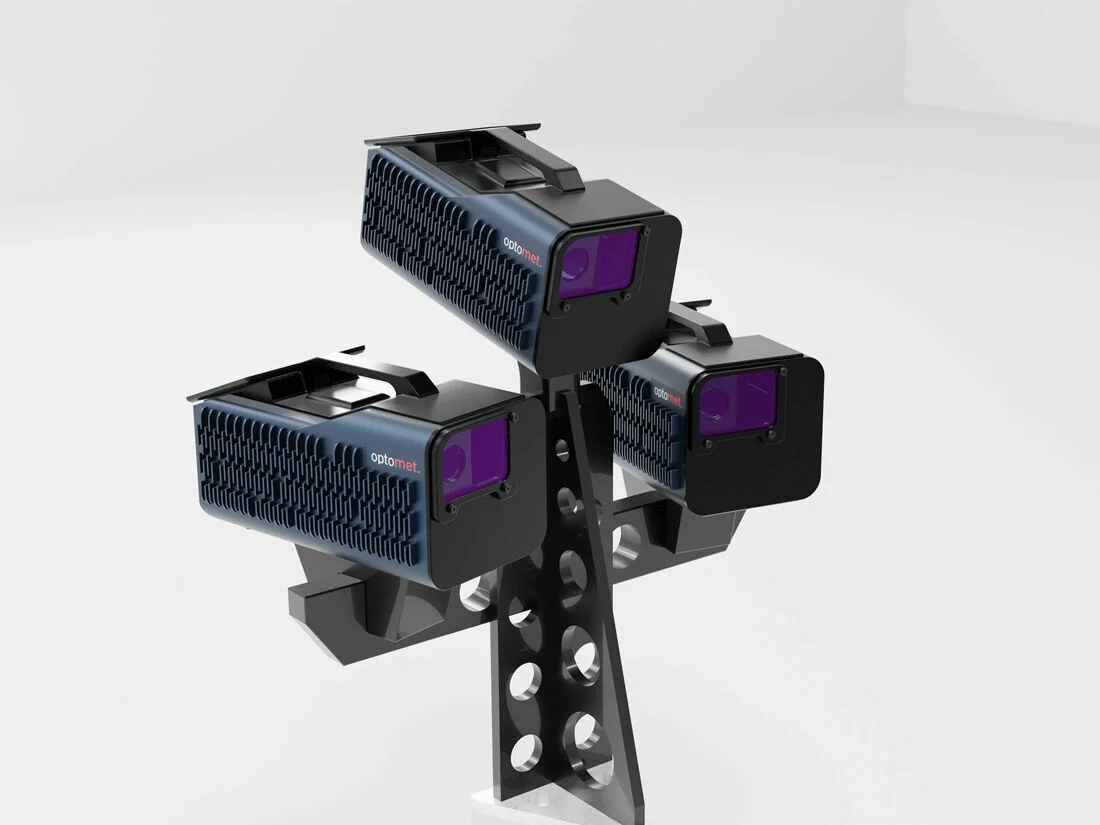
A 3D laser vibrometer measures the vibration of a surface in all three spatial directions without contacting the test object. It uses three synchronised laser beams that measure the same point from different angles at the same time. Each beam records a component along its own direction (u, v, w); the SMART Lab software then transforms these into Cartesian coordinates (x, y, z) aligned with the test object or an imported FEM model. This separates in-plane (tangential) vibration from out-of-plane (normal) vibration and yields the complete three-dimensional displacement vector at every measurement point.
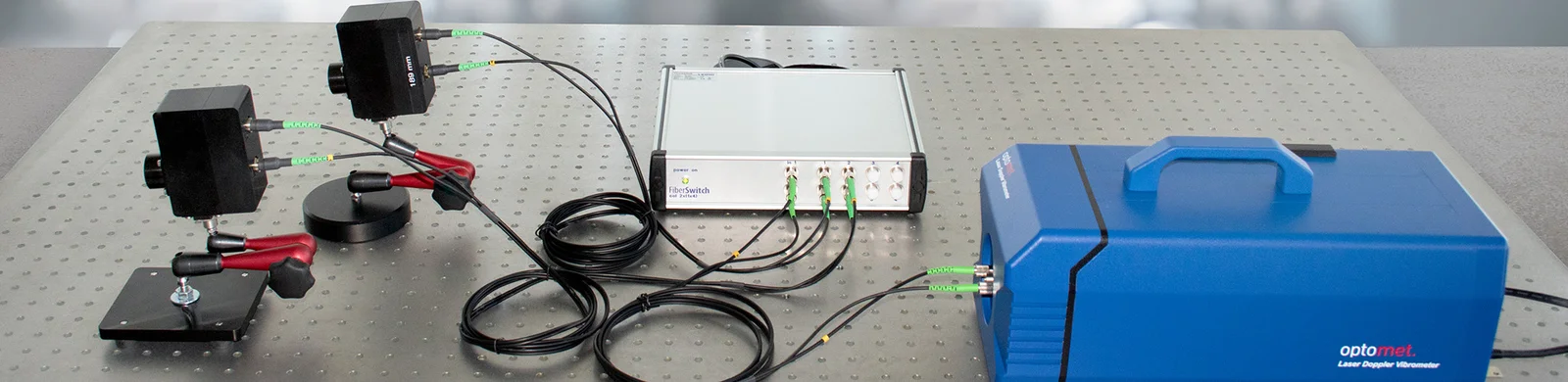
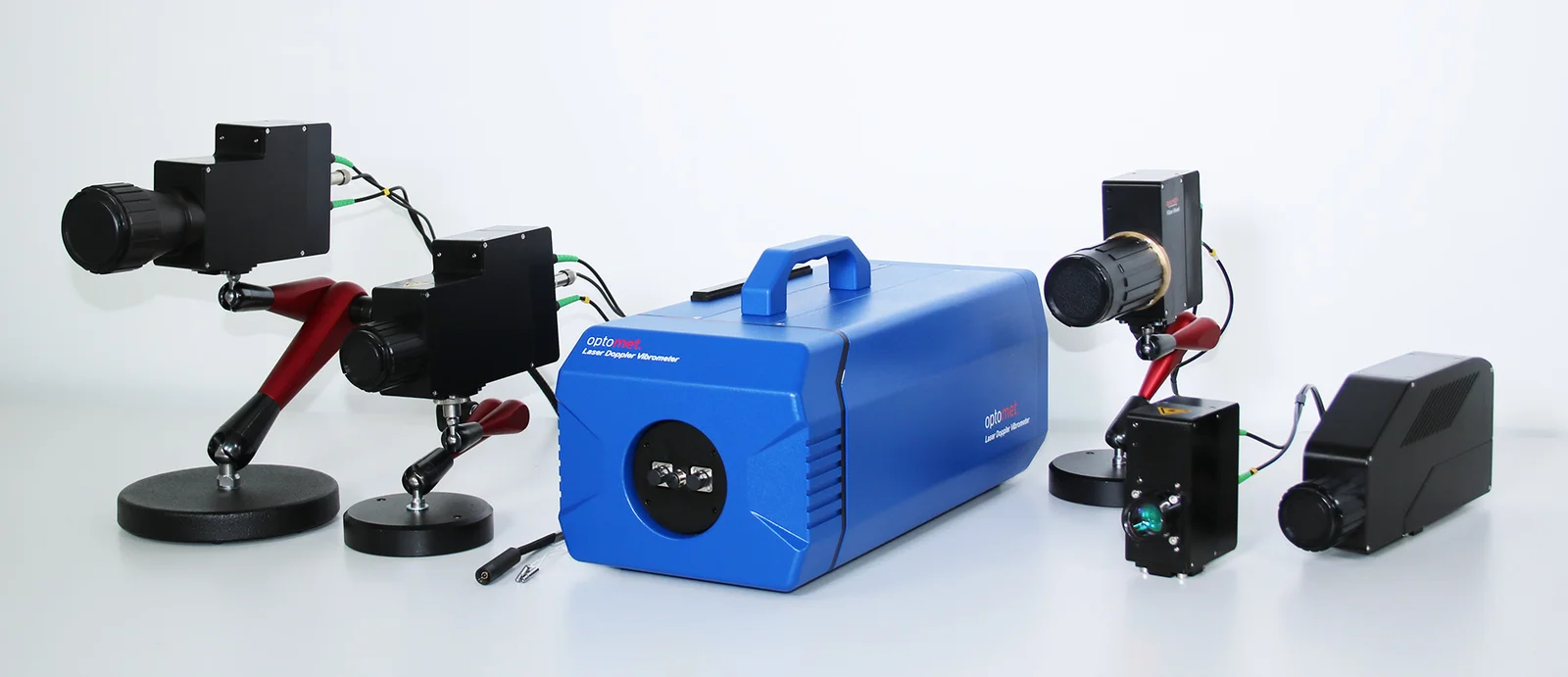
The Optomet 3D line is part of the SMART Series and covers two configurations. The SMART 3D-Scan is a 3D scanning vibrometer built from three synchronised SMART Scan+ vibrometers; it steers the lasers sequentially over up to 512 x 512 measurement points and combines the phase-accurate measurements into complete 3D mode shapes. The SMART 3D-Fiber is a 3D single-point vibrometer with a compact fiber head (107 x 100 x 102 mm, fixed 83 mm working distance) that outputs x, y and z coordinates directly at its analog and digital ports, for use at hard-to-access locations such as gearboxes and engine compartments. The SMART Series is modular: an existing SMART Scan+ can be expanded with two further devices to form a SMART 3D-Scan.
The systems measure a frequency range from DC to 50 MHz and velocities up to 50 m/s. The measurement laser is an eye-safe SWIR source at 1550 nm (class 1), and a visible pilot laser (class 2) is used for alignment. SMART Lab handles automated calibration with error verification, 3D model matching, measurement-point placement on FEM nodes, and the u,v,w to x,y,z transformation, with real-time 3D coordinates available digitally and analogously. Excitation can be applied with a modal hammer, shaker, piezo actuator or under real operating conditions, using the integrated signal generator. Strains and the stresses derived from them can be calculated from the 3D displacement vectors as an alternative to strain gauges.
Applications
Used in turbine blade and blisk vibration analysis, brake squeal investigation (separating in-plane and out-of-plane motion), experimental and operational modal analysis (EMA/OMA) on complex geometries, FEM validation and correlation, and analysis of lightweight structures, composites, hollow bodies and deep-drawn components.
Specifications
- Three synchronised laser beams resolving x, y and z vibration at every point
- Frequency range: DC to 50 MHz; velocity up to 50 m/s
- SMART 3D-Scan: up to 512 x 512 measurement points; working distance approx. 6.5 mm to 100 m
- SMART 3D-Fiber: fixed 83 mm working distance; direct x, y, z output; alternative heads 25 mm to 100 m
- Measurement laser 1550 nm (class 1); pilot laser class 2
- 3D model and FEM import (STL, OBJ, PLY, NASTRAN); FEM-node measurement in SMART Lab
Technical Specifications
- Three synchronised laser beams measure the same point from different angles at the same time
- Components are first recorded in the beam directions (u, v, w), then transformed into Cartesian coordinates (x, y, z)
- Separates in-plane (tangential) and out-of-plane (normal) vibration; full 3D displacement vector at every point
- Frequency range: DC to 50 MHz
- Vibration velocity: up to 50 m/s
- Strain and stress can be derived from the 3D displacement vectors
- Three synchronised SMART Scan+ vibrometers
- Up to 512 x 512 measurement points; sequential phase-accurate scanning of multiple points
- Working distance: approx. 6.5 mm to 100 m, depending on object size and setup
- Supports import of 3D models and FEM (STL, OBJ, PLY, NASTRAN); measurement points can be placed directly on FEM nodes
- Measures the 3D vibration at a fixed measurement point
- Compact fiber head: 107 x 100 x 102 mm; fixed working distance 83 mm
- Integrated webcam for laser alignment
- Direct x, y, z coordinate output at analog and digital ports
- Alternative fiber heads with working distances from 25 mm to 100 m
- Used at hard-to-access locations such as gearboxes and engine compartments
- Measurement laser: eye-safe SWIR, 1550 nm, class 1 (< 10 mW)
- Pilot/alignment laser: visible, class 2 (< 1 mW)
- SMART Lab software: automated calibration with error verification, 3D model matching, FEM node measurement, automatic u,v,w to x,y,z transformation
- Real-time 3D coordinates available digitally and analogously
- Integrated signal generator; excitation via modal hammer, shaker, piezo actuator or operating conditions
Frequently Asked Questions
What is the difference between a 1D and a 3D laser vibrometer?
When is a 3D laser vibrometer required?
What is the difference between in-plane and out-of-plane vibration?
How are the measurements transformed into Cartesian coordinates?
What is the difference between 3D scanning and 3D single-point measurement?
What frequency range can be measured and is the laser eye-safe?
Request a quote for 3D-Laser Vibrometer - Optomet
Fill out the form, give us a call or send an email and we will contact you as soon as possible.