Laser-scanning Vibrometer - Optomet
Optomet laser-scanning vibrometers measure vibration without contact across a grid of up to 512 x 512 points, DC to 50 MHz. Available from Cromocol.
Get a Quote Product Description
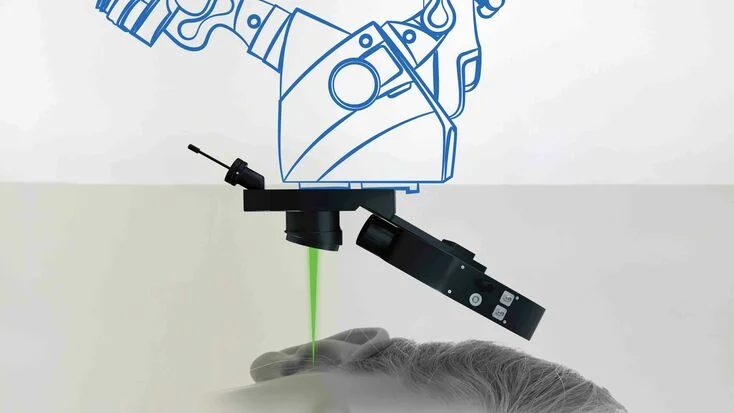
A laser-scanning vibrometer measures surface vibration without contact and resolves it over an area rather than at a single point. The instrument directs a laser beam at the test object and evaluates the Doppler frequency shift of the reflected light, which is proportional to the velocity of the surface at the point being measured. An integrated interferometer recovers this shift at each measurement point, and the beam is steered automatically across a defined grid so that velocity, displacement and acceleration are recorded across the whole surface.
Scan grids of up to 512 x 512 points can be defined, over measurement areas ranging from below 1 mm² to over 10 m². The same measurement principle therefore applies to small components such as printed circuit boards and to large structures. Working distances range from approximately 6.5 mm in close-up configurations to 100 m. Depending on the model, the measurement laser is either a SWIR source at 1550 nm (class 1) or a visible HeNe source at 632.8 nm (class 2); the SWIR variant returns sufficient signal from most surfaces without reflective tape.
The full-field data is used to visualise operational deflection shapes, wave propagation and mode shapes, and to determine modal parameters. Common applications include validation of finite-element models, structural dynamics and NVH investigations, and acoustics and ultrasonics measurements.
Product Line
Optomet offers laser-scanning vibrometry across two product families:
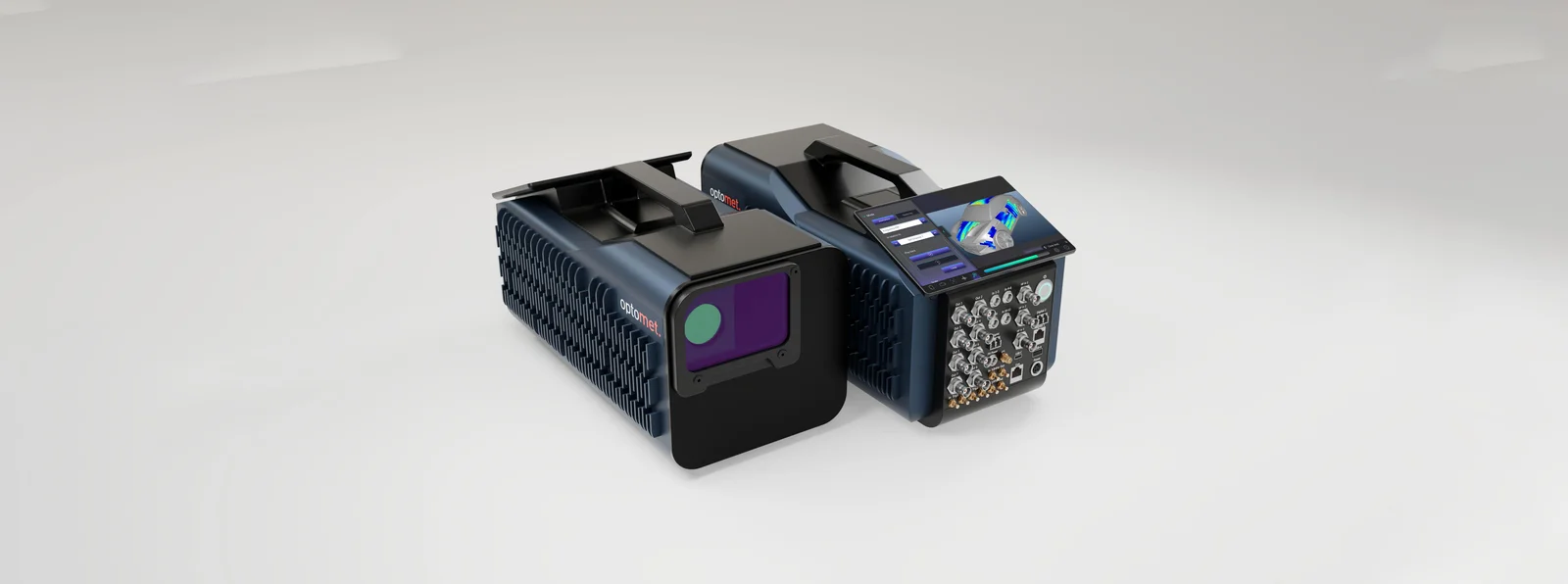
- SMART Scan+ — a 1D scanning vibrometer covering a frequency bandwidth from DC to 50 MHz.
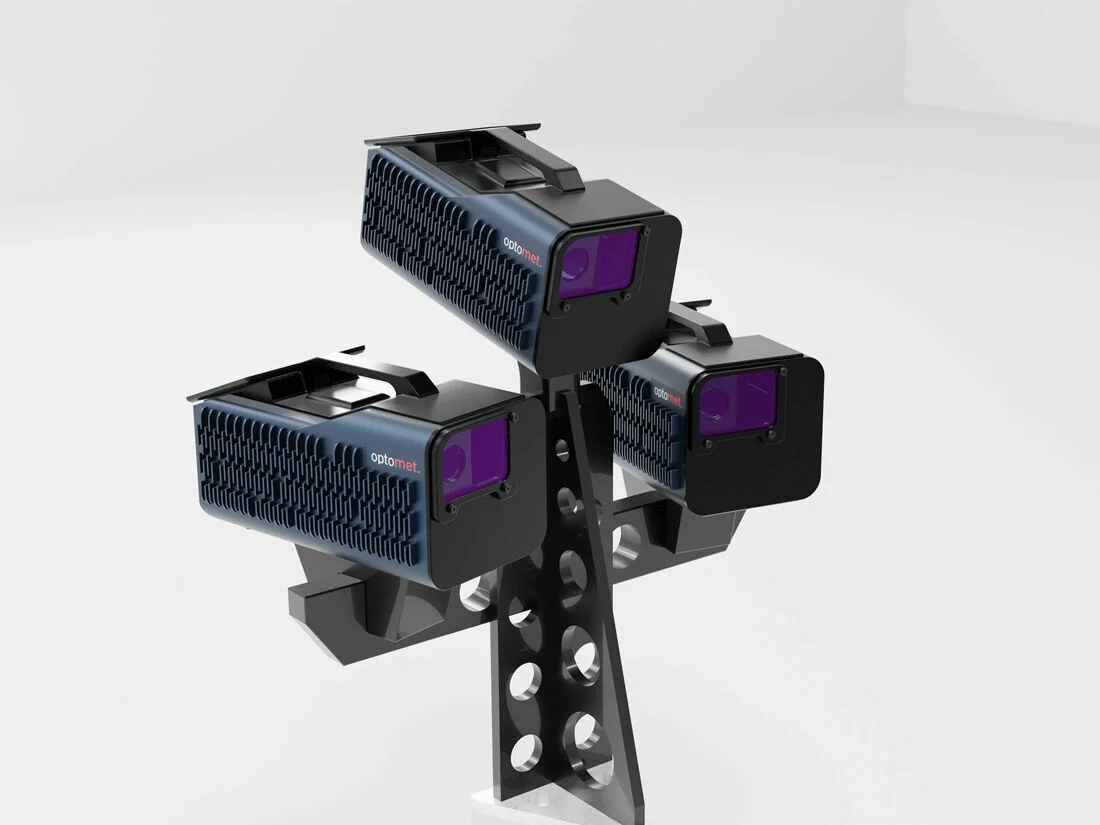
- SMART 3D-Scan — three synchronised vibrometers that resolve vibration in three dimensions.
- SMART Full Body — multiple synchronised units that scan different regions of a structure in parallel.
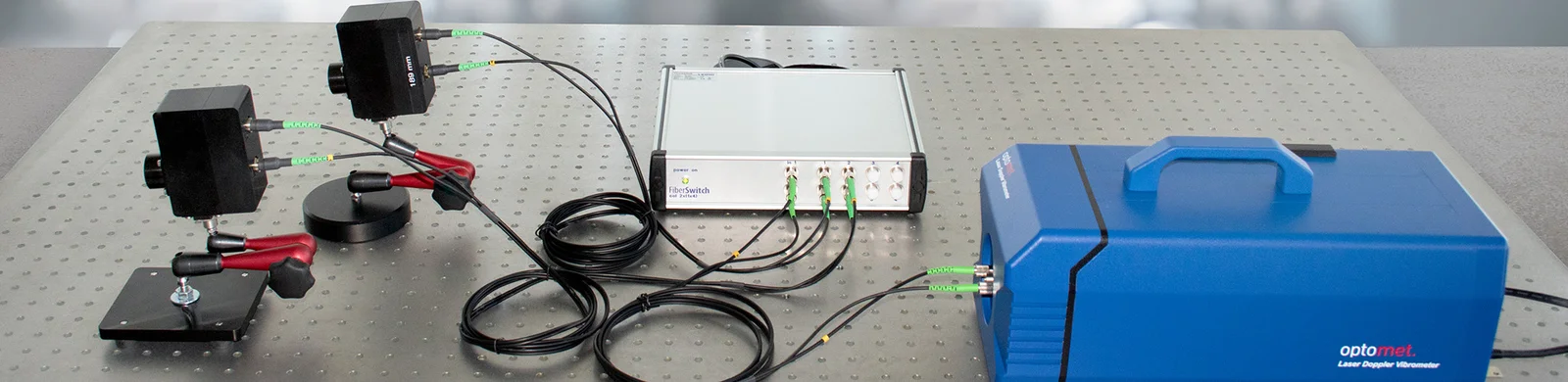
- CLASSIC Scanning Vibrometer — a compact 1D scanning system covering DC to 25 MHz.
The SMART Series provides up to 12 reference channels and connects over Gigabit Ethernet, analog outputs and external triggers for integration into test stands.
Technical Specifications
- Method: non-contact laser Doppler vibrometry; evaluates the Doppler frequency shift of laser light reflected from the moving surface
- Measured quantities: velocity, displacement, acceleration
- Scanning: laser beam automatically directed across a defined measurement grid, recording each point in sequence
- Scan point density: up to 512 x 512 measurement points
- Measurement area: from below 1 mm² to over 10 m²
- Max. scan points per second: up to 50
- Frequency bandwidth: DC to 50 MHz (SMART Series); DC to 25 MHz (CLASSIC Series)
- Max. vibration velocity: up to 50 m/s
- Laser source: SWIR 1550 nm (class 1) or visible HeNe 632.8 nm (class 2)
- Working distance: from approx. 6.5 mm (close-up) to 100 m
- Connectivity: Gigabit Ethernet, analog outputs, external triggers
- Reference channels: up to 12 (SMART Series)
- SMART Scan+: 1D scanning vibrometer
- SMART 3D-Scan: three synchronised heads for 3D vibration measurement
- SMART Full Body: multiple synchronised units for parallel full-body scanning
- CLASSIC Scanning Vibrometer: compact 1D scanning system
Frequently Asked Questions
How does a laser-scanning vibrometer measure vibration?
How many points can the system scan, and over what area?
Are scan points measured simultaneously or one at a time?
Is surface preparation or reflective tape required?
Can the system measure vibration in three dimensions?
What frequency and velocity ranges are covered?
Request a quote for Laser-scanning Vibrometer - Optomet
Fill out the form, give us a call or send an email and we will contact you as soon as possible.